
What the FDA is expected to approve in 2026–2027
If you follow peptide science, the regulatory calendar is one of the clearest signals of where the field is heading. Peptides are no longer a niche — roughly 130 peptide-based drugs are already FDA-approved, from insulin and the GLP-1 blockbusters to oncology imaging agents. When a new compound class moves through the FDA it usually reflects years of published research, and it tends to shape what the wider research community studies next. Here’s a plain-English snapshot of what’s approved and what’s moving through the pipeline in 2026–2027.
Context, not endorsement. This article describes pharmaceutical products developed and regulated by their manufacturers. MrPep does not sell medicines. Any compound we list is supplied strictly as a reference material for laboratory research and is not for human or animal consumption. Approval timelines shift; treat dates as indicative.
The approved backdrop
The GLP-1 class is what put peptides in the headlines. Semaglutide is approved as Ozempic (2017, type-2 diabetes), Rybelsus (2019, the oral form) and Wegovy (2021, weight management); tirzepatide, a dual GIP/GLP-1 agonist, followed as Mounjaro (2022) and Zepbound (2023). But the approved list stretches far beyond metabolism — recent nods include elamipretide (Forzinity) for Barth syndrome, palopegteriparatide (Yorvipath) for hypoparathyroidism, and peptide imaging agents used in surgery. It’s a reminder that “peptide” spans a huge range of chemistry and use.
Already across the line: the first oral GLP-1
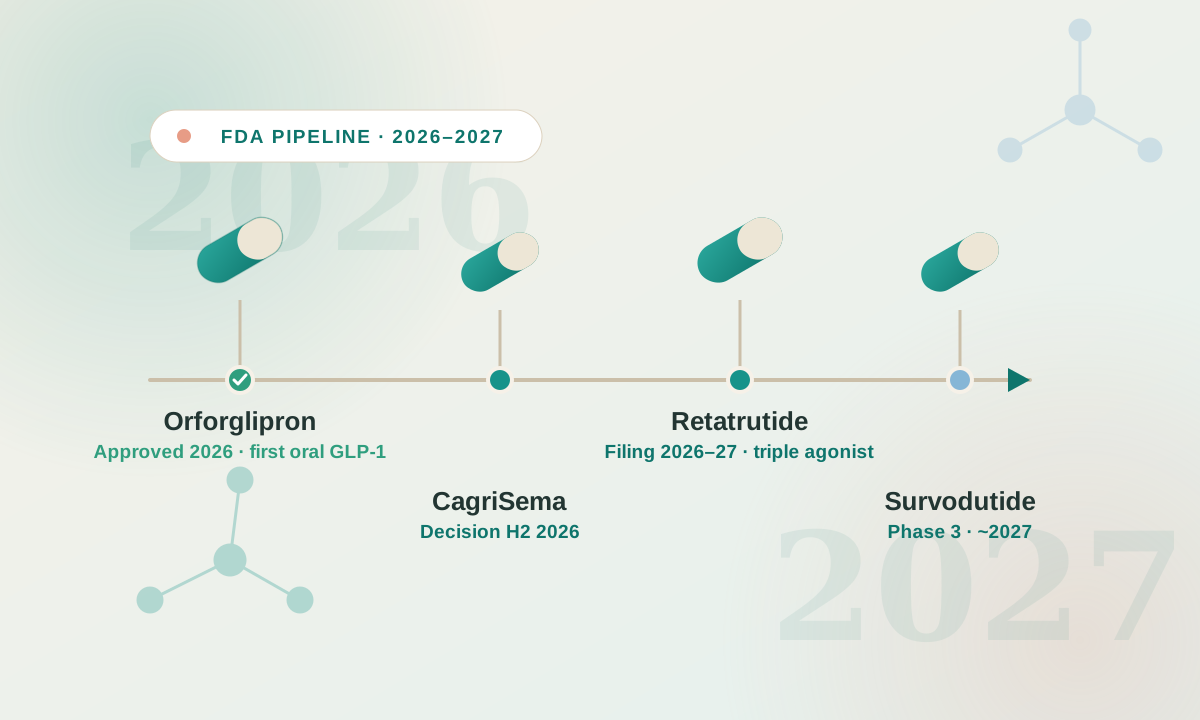
The headline event of early 2026 was the approval of orforglipron (brand name Foundayo) — the first orally-dosed GLP-1 receptor agonist to reach the market. Until now this class had been almost entirely injectable, so a small-molecule oral option is a genuine inflection point and has driven a wave of renewed interest in GLP-1 biology among researchers.
Decisions expected during 2026
The most-watched near-term decision is CagriSema (Novo Nordisk), a fixed combination of the amylin analogue cagrilintide with semaglutide. Following a filing in late 2025, an FDA decision is anticipated in the second half of 2026. As a combination of two distinct mechanisms, it’s a useful case study in how multi-target approaches are assessed.
Filings and decisions on the 2027 horizon
Two next-generation programmes are the ones to watch further out:
- Retatrutide (Eli Lilly) — a GIP/GLP-1/glucagon “triple agonist”. Additional Phase 3 read-outs from the TRIUMPH programme are expected across the second half of 2026, with a regulatory filing likely in late 2026 or early 2027 and a decision window opening in 2027–2028.
- Survodutide (Boehringer Ingelheim / Zealand Pharma) — a GLP-1/glucagon dual agonist currently in the Phase 3 SYNCHRONIZE programme, with a projected submission around 2027.
The pipeline at a glance
| Compound | Mechanism | Stage / expected milestone |
|---|---|---|
| Orforglipron | Oral GLP-1 | Approved (April 2026) |
| CagriSema | Amylin + GLP-1 | FDA decision expected H2 2026 |
| Retatrutide | GIP / GLP-1 / glucagon | Phase 3 read-outs H2 2026; filing late 2026–2027 |
| Survodutide | GLP-1 / glucagon | Phase 3; submission ~2027 |
Watch: how GLP-1 agonists work
If the mechanism is new to you, this short third-party animation explains how GLP-1 receptor agonists act:
Watch: GLP-1 mechanism of action
“Approved” and “research-only” are not the same thing
This is the part worth underlining. Being an approved medicine is a specific regulatory status. Many compounds studied in labs — BPC-157 is a well-known example — are not FDA-approved for any human use and remain strictly research materials. A drug reaching the market does not change the status of a research analogue, and it never makes a research compound suitable for human or animal use.
Why it matters for the research community
Regulatory momentum in a compound class almost always precedes a surge in independent, exploratory laboratory work — new analogues, formulation studies, stability work and analytical method development. That is exactly the context in which reference-grade material and independent batch verification matter: reproducible research depends on knowing precisely what is in the vial. Whatever a compound’s regulatory story, documentation beats hype — which is why every MrPep listing links to its independent certificate.
This article is educational and does not constitute medical, clinical, investment or usage advice. It does not describe any MrPep product’s effects and does not suggest human or animal use of any compound. Dates and statuses are indicative and change — verify against current FDA sources.
See how our compounds are tested
Independent HPLC purity and Mass Spec identity data, published per compound.