
Net peptide content: what it is and why purity does not cover it
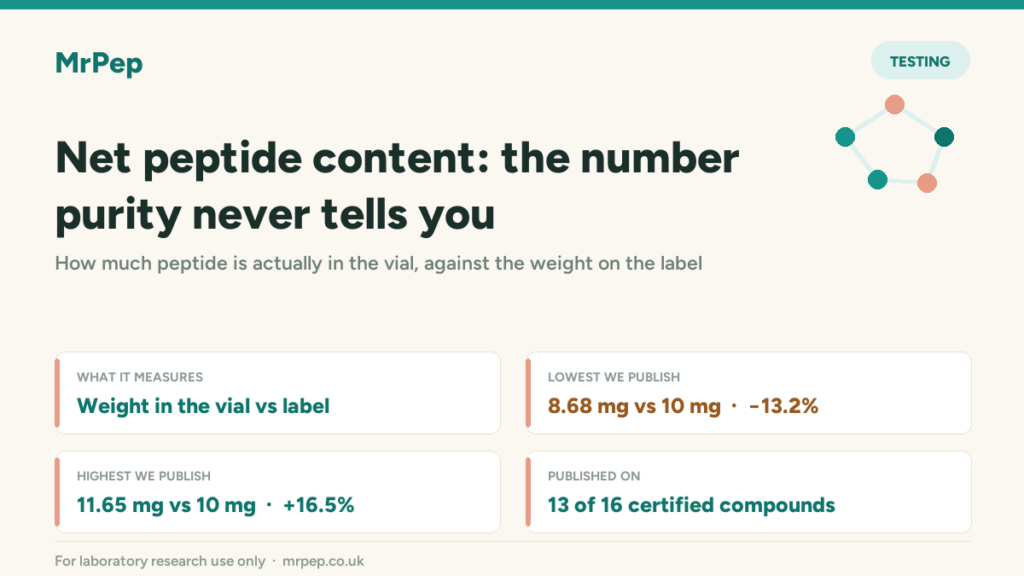
Purity tells you how much of what is in the vial is the compound named on the label. It tells you nothing about how much is in there. Net peptide content answers that second question, and it is the number most suppliers never publish.
Two different measurements
A vial can be 99.8% pure and still be short. Purity is a ratio — the proportion of the material present that is the stated compound. Net peptide content is a mass — the actual weight of peptide in the vial, measured against the weight printed on the label. A 10 mg vial containing 8.7 mg of 99.7% pure peptide is exactly that: very pure, and 13% short.
The two are independent, in the same way purity and identity are independent. A certificate reporting only purity has answered one of the three questions worth asking.
Why the number moves
Lyophilised peptide is filled by weight before freeze-drying, and small variations in the fill step carry through to the finished vial. Residual moisture, counter-ion content and the peptide’s own hygroscopic behaviour all shift the measured mass. Some variation is normal. A consistent bias in one direction is a process problem rather than noise.
What a reasonable tolerance looks like
Analytical laboratories generally state their own specification on the certificate. SteriGenix, for example, prints ±10% against the label claim. Some supplier-generated summary documents apply far looser criteria — one repository we have seen passes anything at 80% of label claim or above, a 20% underfill allowance. That is a commercial guarantee, not an analytical specification, and it is worth checking which of the two you are reading.
What we publish
MrPep publishes net peptide content wherever the certificate reports it, on the product page and in the full certificate record, with the percentage difference from the label shown alongside. Values more than 10% from the label are flagged rather than omitted.
That includes results that do not flatter us. One BPC-157 batch measured 8.68 mg against a 10 mg label — 13.2% under — and it is published with that figure visible. Selank and Semax batches measured roughly 16% over label. Publishing only the favourable numbers would make the exercise meaningless, so we publish the set.
How to check it yourself
On any certificate, look for a line named Net Peptide Content, Net Content or Quantity. It will normally appear beside the label claim, sometimes with a stated tolerance. For a blend, expect a component breakdown — each peptide measured separately, summing to the blend total. If the line is absent, the test was not performed, and no assumption should be made from the purity figure alone.
What it does not tell you
Net content is a mass measurement on one sample from one batch. It says nothing about sterility, endotoxin load, or how the material has been stored since. It is one line on a certificate, not a verdict on a product.
For laboratory research use only. Not for human or animal consumption; not a medicine, food, supplement or cosmetic. Nothing on this page is dosing, medical or administration guidance.
See how our compounds are tested
Independent HPLC purity and Mass Spec identity data, published per compound.