
Retatrutide: the current research landscape
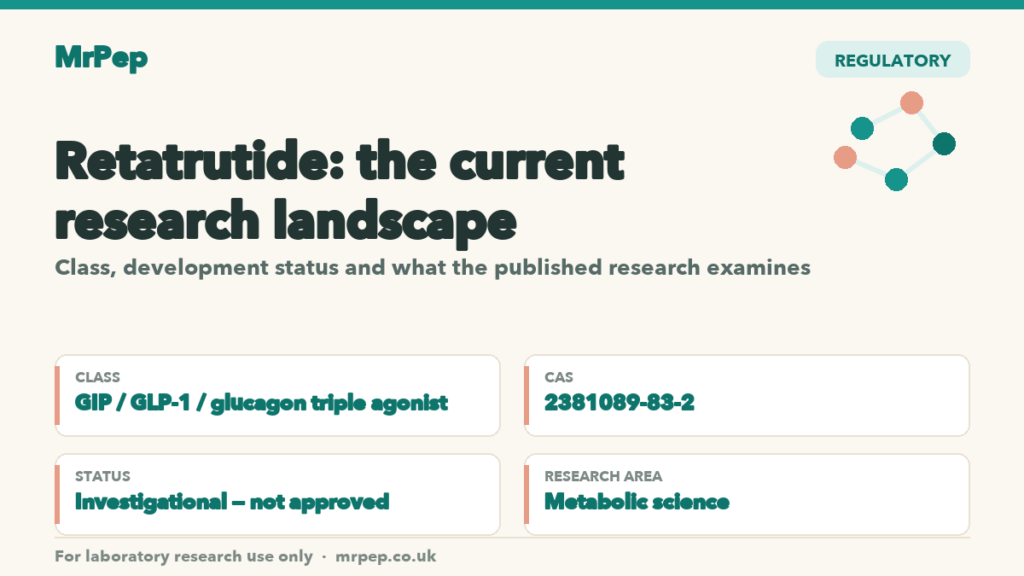
Retatrutide is a synthetic peptide that has become one of the most-discussed compounds in metabolic research. It is described in the literature as a triple receptor agonist, engaging the GIP, GLP-1 and glucagon receptors. This article is a research-oriented overview only: it does not describe use in people or animals.
What it is
Chemically, retatrutide belongs to the same broad family as other incretin-based peptides studied in metabolic science. Its defining feature in the research literature is that it acts at three receptors rather than one, which is why it is frequently referenced alongside single- and dual-agonist compounds when researchers compare mechanisms.
Development and regulatory status
Retatrutide is investigational. It has been evaluated in company-sponsored clinical trials and remains, at the time of writing, not approved by the FDA, MHRA or EMA for any use. That status is central to how it should be understood: it is a compound under study, and any material supplied for laboratory work is a reference material, not a medicine. For the wider approvals picture, see our FDA pipeline overview and approved drugs vs research compounds.
What the research examines
Published trial work has focused on metabolic endpoints. In a research setting, scientists are interested in the pharmacology of multi-receptor agonism, structure–activity relationships, and how such peptides behave analytically. None of that translates into guidance for use — it is the scientific context that makes retatrutide a notable reference material.
How retatrutide is handled in the laboratory
Like our other reference materials, it is supplied as a lyophilised (freeze-dried) powder in a sealed vial. Researchers reconstitute it with a diluent such as bacteriostatic water before use. Every batch is independently verified by HPLC, mass spectrometry and an endotoxin (LAL) screen; see our testing standards or look a batch up on Verify a Batch.
Available from MrPep
Supplied as lyophilised, batch-verified research reference materials (see our testing standards and Verify a Batch):
Related reading
- The GLP-1 research landscape
- Approved drugs vs research compounds
- What the FDA is expected to approve in 2026–2027
For laboratory research use only. Not for human or animal consumption; not a medicine, food, supplement or cosmetic. Nothing on this page is medical advice, a recommendation, or a claim of any effect in humans or animals.
See how our compounds are tested
Independent HPLC purity and Mass Spec identity data, published per compound.