
Bioregulator peptides: Pancragen, Crystagen and the short-peptide field
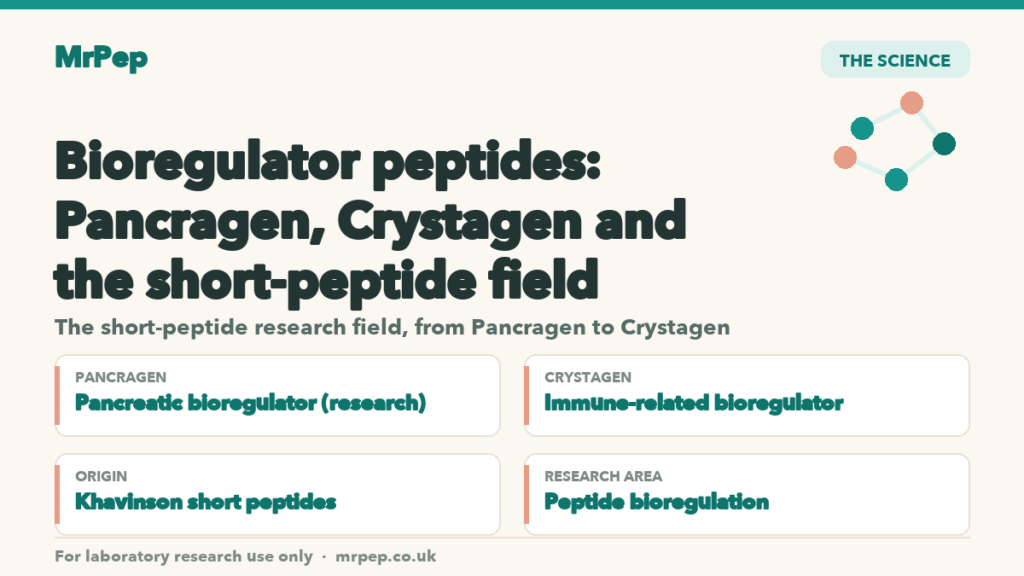
“Bioregulator” is a term from Russian peptide science for very short peptides — often just two to four amino acids — studied for tissue-associated activity in research models. Pancragen and Crystagen are two commonly referenced examples. This is an educational overview of the field only.
The short-peptide concept
The bioregulator field, associated with the work of Vladimir Khavinson, studies whether very short peptide sequences behave in tissue-specific ways in laboratory models. Their small size makes them clean, well-defined reference materials.
Pancragen and Crystagen
In the literature Pancragen is discussed in a pancreatic-research context and Crystagen in an immune-research context. These are descriptions of the research areas the peptides are studied against — not statements about any effect in people or animals.
How bioregulator peptides is handled in the laboratory
Like our other reference materials, it is supplied as a lyophilised (freeze-dried) powder in a sealed vial. Researchers reconstitute it with a diluent such as bacteriostatic water before use. Every batch is independently verified by HPLC, mass spectrometry and an endotoxin (LAL) screen; see our testing standards or look a batch up on Verify a Batch.
Available from MrPep
Supplied as lyophilised, batch-verified research reference materials (see our testing standards and Verify a Batch):
Related reading
- Epithalon (Epitalon): a research overview
- How research peptides are made
- Research peptides drawing attention in 2026
For laboratory research use only. Not for human or animal consumption; not a medicine, food, supplement or cosmetic. Nothing on this page is medical advice, a recommendation, or a claim of any effect in humans or animals.
See how our compounds are tested
Independent HPLC purity and Mass Spec identity data, published per compound.