
Research peptides drawing attention in 2026
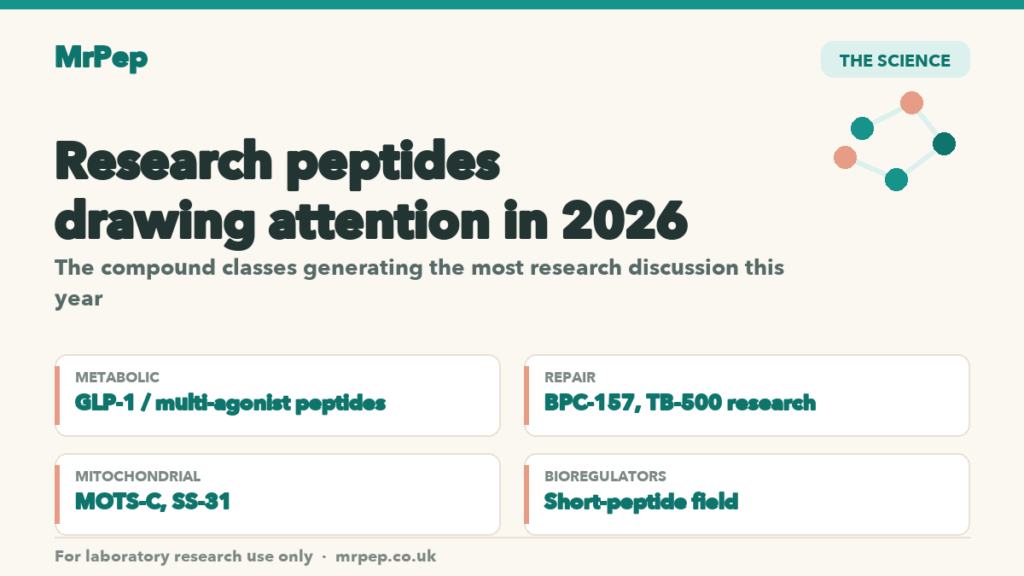
Interest in research peptides tends to cluster around a handful of compound classes. Rather than chase social-media trends, this roundup groups the peptides drawing attention by the science and the regulatory conversation. Everything below is research context only.
Metabolic / incretin peptides
The GLP-1 family and newer multi-receptor agonists remain the most-referenced group, driven by an active clinical pipeline. See our GLP-1 landscape and retatrutide overview.
Repair and cytoprotection research
Peptides such as BPC-157 and TB-500 are widely studied in tissue and cell research. They are not approved for any use and are handled strictly as reference materials.
Mitochondrial peptides
MOTS-C and SS-31 anchor a growing body of mitochondrial research — covered in our mitochondrial peptides article.
Short-peptide bioregulators
The Khavinson-style short peptides (bioregulators) are a distinct research field attracting renewed academic attention.
What unites these is scientific interest and, in several cases, an active regulatory story — not any established use. Attention is not endorsement.
Available from MrPep
Supplied as lyophilised, batch-verified research reference materials (see our testing standards and Verify a Batch):
- Retatrutide — research reference material
- Tirzepatide — research reference material
- BPC-157 + TB-500 — research reference material
- MOTS-C — research reference material
- SS-31 — research reference material
Related reading
For laboratory research use only. Not for human or animal consumption; not a medicine, food, supplement or cosmetic. Nothing on this page is medical advice, a recommendation, or a claim of any effect in humans or animals.
See how our compounds are tested
Independent HPLC purity and Mass Spec identity data, published per compound.