
What to check before buying research peptides in the UK
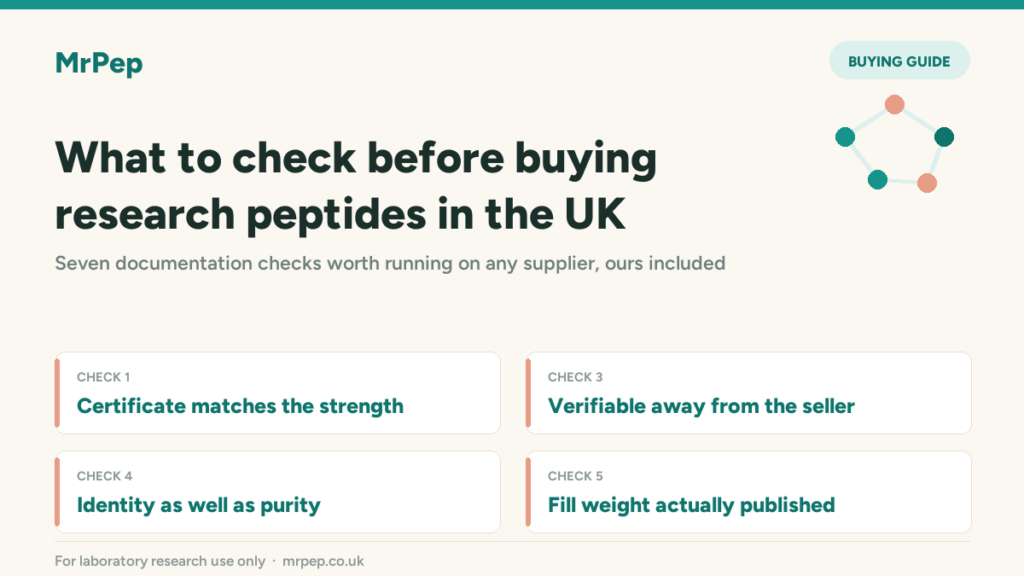
Research compounds are sold in the UK with wildly varying levels of documentation, from full analytical packages down to a product photograph and a promise. These are the checks worth running before you order from anyone, ours included.
1. Is there a certificate at all, for the strength you are buying?
The commonest gap is not a missing certificate but a mismatched one. A certificate issued against a 5 mg vial does not cover the 10 mg product on the page, and a certificate for BPC-157 alone does not cover a BPC-157 and TB-500 blend. Check the compound and the strength on the document, not just the presence of a PDF.
2. Who commissioned the test?
There are three meaningfully different situations, and they are not equally strong:
- The manufacturer’s own certificate. Useful, but the party with the commercial interest chose the laboratory and the sample.
- A third-party certificate. An independent laboratory, though usually still commissioned by the supplier.
- A test the seller paid for themselves, on stock they already hold. This is the strongest of the three, because the seller had every opportunity to bury an unflattering result and did not.
A shop that distinguishes between these on the page is telling you something. One that presents all three as simply “tested” is not.
3. Can you verify it away from their website?
Ask for the laboratory’s verification code or link. Most analytical laboratories issue one. If the certificate cannot be retrieved anywhere except the seller’s own server, you are trusting the seller, not the laboratory. Our guide to checking a certificate at the laboratory covers the formats.
4. Does the purity figure come with an identity figure?
Purity by HPLC tells you how much of the material is a single compound. It does not tell you which compound. Only mass spectrometry confirms identity. A certificate with a purity number and no identity confirmation has answered half the question — see purity vs identity.
5. Is the fill weight published?
Almost nobody publishes this, and it is the check that separates paperwork from measurement. Net peptide content is the actual weight of peptide in the vial against the weight on the label. A vial can be 99.8% pure and 13% short, and purity alone will never tell you.
6. How does the shop describe what it sells?
In the UK these materials are supplied for laboratory research use only. They are not medicines, foods, supplements or cosmetics, and they are not for human or animal consumption. A supplier who implies otherwise — dosing tables, before-and-after imagery, health claims — has told you how carefully they read the rules that also govern their analytical claims.
7. Practical things people forget
Check where stock is held, because an overseas parcel makes you the importer of record. Check whether the returns position is stated. Check whether the payment method is one you can trace. And check whether the site says who they are.
Where MrPep stands on its own checklist
We publish the full position rather than a summary: sixteen compounds with certificates, three independent laboratories, every certificate checkable at the laboratory that issued it, thirteen with net peptide content published — including three fill weights outside ±10% that are flagged rather than removed. Seven products carry no certificate at the strength we stock and are labelled COA pending. All of it is on the certificate record.
For laboratory research use only. Not for human or animal consumption; not a medicine, food, supplement or cosmetic. This article is general guidance on documentation, not advice on any product’s suitability for any purpose.
See how our compounds are tested
Independent HPLC purity and Mass Spec identity data, published per compound.